Microsoft ends support for Internet Explorer on June 16, 2022.
We recommend using one of the browsers listed below.
- Microsoft Edge(Latest version)
- Mozilla Firefox(Latest version)
- Google Chrome(Latest version)
- Apple Safari(Latest version)
Please contact your browser provider for download and installation instructions.



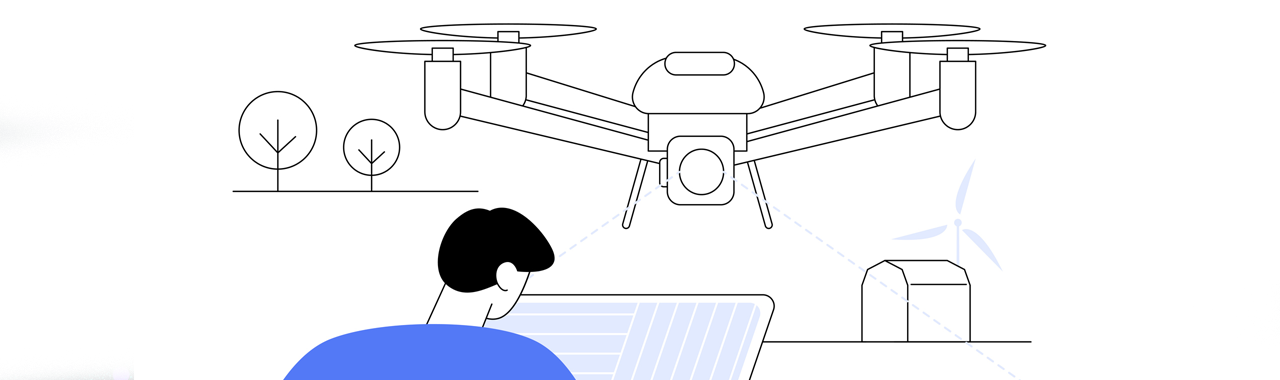
There’s a particular moment when you’re operating a drone where things stop feeling intuitive. The controls are still responding and the connection is active, but the video feed starts to stutter, smear, or come through in uneven bursts.
If you’re trying to conduct a drone inspection, loss of visual stability isn’t just a pain, it’s the moment you feel you have to pull the plug and call the drone back.
Better Visual Stability
NTT, NTT-ME and NTT e-Drone Technology are working to fix the problem.
The three partners recently conducted a joint demonstration focused on stabilizing video transmission for remotely operated drones, specifically targeting a persistent wireless headache: delay variation, also known as jitter.
Fundamentally, remote drone piloting relies on a continuous feedback loop. The drone captures video, sends it to the operator, and the operator reacts with control inputs. If that stream becomes inconsistent, even for a second, the ability to make precise movements is harmed. In tight environments like construction sites or industrial facilities, where obstacles are inches away, loss of precision can be a major liability.
Wireless Communication Can Be Patchy
The problem is that wireless communication isn't always a steady stream. Data packets often arrive at irregular intervals, especially when network conditions fluctuate. You don’t necessarily lose the connection, but the timing gets distorted, resulting in flickering, blocky noise, or motion that feels somehow off.
The NTT Group companies’ idea isn't about trying to fix the variability in wireless signals, which can be a losing battle. It’s more about making it so that the system compensates for variability across the combined optical and wireless network. By analyzing traffic data at the base station, the proposed system could actually adjust the timing of video frames as they pass through the optical backbone.
Controlling The Data Flow
It’s about reshaping the flow of data so that frames arrive at the operator’s screen at regular intervals. Even if the underlying wireless link is uneven, the operator sees a smooth, predictable image, thereby bringing the video closer to an "ideal" pattern, which is much easier for the human brain to process in real time.
To test the tech, NTT, NTT-ME and NTT e-Drone Technology recently set up a remote control environment spanning roughly 60 kilometers, linking a drone at the Fukushima City Robot Test Field with an operator in Koriyama, south-west of the city. They used a combination of local 5G for the wireless segment and a FLET’S VPN for the optical backbone to see how the system handled real-world distance.
Under heavy transmission loads, visible distortion typically appeared about 12.3% of the time. With stabilization applied, however, that figure dropped to just 4.6%.
Stability Is The Key
Stabilization affects how operators behave in practice. When video is unreliable, drone pilots tend to pause or slow down to be safe, which drags out the time required to finish a job. The trial results made this clear. A round-trip maneuver that took 35 seconds under direct visual control was completed in just 32 seconds via remote operation, when the stabilized video was used. This suggests that the remote setup didn't slow operation in practice.
Better Use Of Human Resources
Let’s think about the bigger picture. Japan has a growing need for remote inspection. Its labor shortages are becoming more acute, particularly in infrastructure maintenance, and drones offer a way to inspect bridges and plants without sending a full crew on-site. They can only feel confident in doing so, however, if they know they will be guided safely and precisely from a distance.
While fully automated drone flight works for predictable, known areas, human input is still needed to navigate complex or changing environments such as factories. In those kinds of scenarios, a pilot needs to see exactly what’s happening in real time. That makes high-quality video a fundamental requirement, rather than just a convenience.
Happy Drones
Looking ahead, NTT’s technology could potentially extend well beyond drones. Any remote system that depends on real-time video—from industrial robots to unmanned ground vehicles—has the same potential issues. The three NTT partners are exploring wider applications and moving toward practical, everyday deployment.
Imagine it. A video feed stable enough for drone operators to work without constant interruptions. A stability that allows remote control to move from being a controlled demonstration to a practical tool, allowing for critical inspection work to take place without the need for people to be physically on-site. Coming soon.
Innovating a Sustainable Future for People and Planet
For further information, please see this link:
https://group.ntt/en/newsrelease/2026/05/14/260514a.html
If you have any questions on the content of this article, please contact:
Public Relations
NTT
https://tools.group.ntt/en/news/contact/index.php

Daniel O'Connor
Daniel O'Connor joined the NTT Group in 1999 when he began work as the Public Relations Manager of NTT Europe. While in London, he liaised with the local press, created the company's intranet site, wrote technical copy for industry magazines and managed exhibition stands from initial design to finished displays.
Later seconded to the headquarters of NTT Communications in Tokyo, he contributed to the company's first-ever winning of global telecoms awards and the digitalisation of internal company information exchange.
Since 2015 Daniel has created content for the Group's Global Leadership Institute, the One NTT Network and is currently working with NTT R&D teams to grow public understanding of the cutting-edge research undertaken by the NTT Group.
Related Article


Recommended Article
-

March 14, 2024
What is NTT's GX? Our solution brand "NTT G×Inno"
-

March 5, 2024
[Press Conference Information] Launch of "NTT G×Inno," a New Solution Brand to Strengthen Efforts in the GX Field
-

January 15, 2024
Digitization and Digitization for Smart Agriculture
-

November 17, 2023
Realizing a Recycling-Oriented Society through a Data Mining Approach
Search by Tags