Microsoft ends support for Internet Explorer on June 16, 2022.
We recommend using one of the browsers listed below.
- Microsoft Edge(Latest version)
- Mozilla Firefox(Latest version)
- Google Chrome(Latest version)
- Apple Safari(Latest version)
Please contact your browser provider for download and installation instructions.


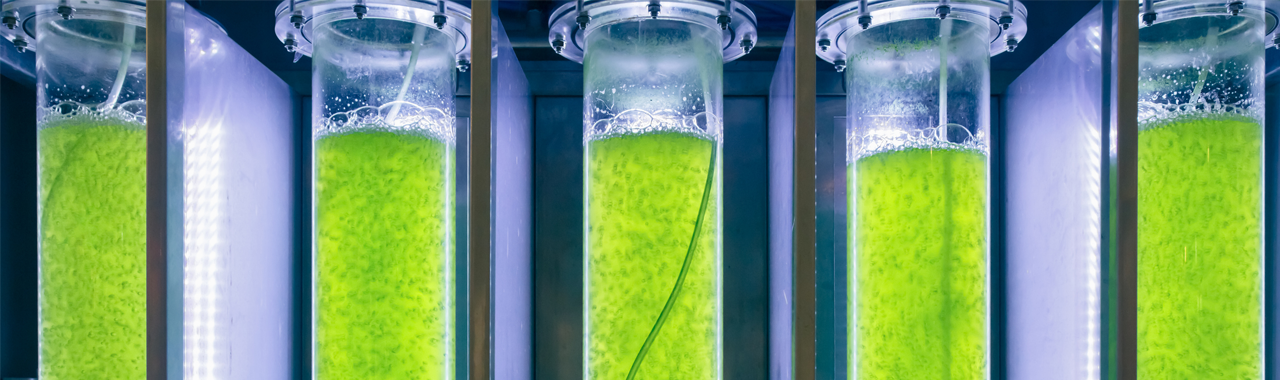
Carbon dioxide gets a lot of bad press. You usually hear about it as being a greenhouse gas whose emissions need to be reduced. And that is true, it is thought to be one of the causes of climate change.
CO₂ is Food
But as far as microalgae are concerned, CO₂ is also a raw material. Just like plants, they use carbon through photosynthesis to live and grow.
The growth of microalgae produces biomass, which can then potentially be used in animal feed, fuels and chemicals. It’s not too much of a stretch to think that replacing some conventional feedstocks with algae-based biomass could help contribute to more sustainable production and lower greenhouse gas emissions.
Growing and Using Biomass
It’s something that NTT has been exploring for several years. The Group’s recent research has included work on using algae as feed for fish and shellfish, identifying genes associated with greater CO₂ uptake, developing breeding techniques using neutron irradiation, and increasing useful fatty acids in diatoms used for aquaculture feed.
The company’s latest research looks at another part of the challenge: if algae are to be cultivated more efficiently going forward, we need to know how much carbon they are absorbing, when they are absorbing it and how changes in growing conditions affect that process. Sounds relatively straightforward, right? It’s not.
Measuring Carbon
CO₂ dissolved in water doesn’t just remain as CO₂; it can also take other chemical forms. Taken together, these various forms are known as dissolved inorganic carbon, or DIC. Tracking DIC gives researchers a better picture of the carbon available to microalgae and how much they are using.
Until now, researchers have faced an either/or trade-off. They have traditionally used titration, a chemical testing method, to measure DIC. It’s accurate, but samples have to be taken and measured manually, so it only provides snapshots over time.
Using sensors offers a second approach and can monitor DIC continuously. The problem is that, when it comes to microalgal cultures, their readings become increasingly inaccurate as cultivation progresses.
Acid/Alkaline
So NTT looked into why that was. It turns out that as the algae grow, the pH nature of the culture fluid changes and becomes more alkaline. The NTT research team found that these changes were closely related to errors in the sensor-based calculations. Consequently, they developed a correction method that adjusts the calculated DIC concentration according to the changing pH acidity-alkalinity.
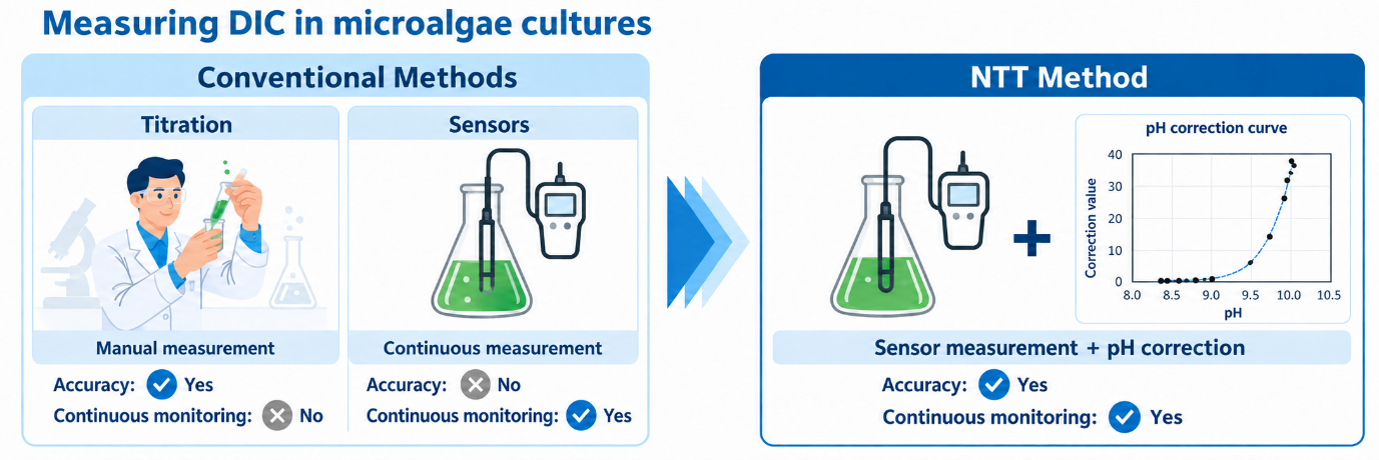 Comparing conventional and NTT's new methods for measuring DIC dynamics in microalgal cultures
Hugely Reduced Error Rate
They saw an immediate difference. Compared with measurements obtained using the conventional method, the maximum relative error fell from around 3,300%—not a typo—before correction to around 8% afterward. Bringing the maximum error down this far means that researchers can get a much more accurate picture of what’s happening inside an algal culture, without having to rely only on irregular, manual measurements.
NTT demonstrated its new correction method by growing microalgae under alternating periods of light and darkness. During the light periods, the amount of carbon in the culture system fell in a way that matched the algae absorbing CO₂ through photosynthesis; in darkness, the pattern changed. The new method was able to follow those changes continuously over time. All of which means: once you can see how carbon uptake changes, you can start asking what’s causing those changes.
Understanding Carbon
NTT plans to use its research data to examine different cultivation conditions, including the amount of CO₂ supplied, lighting, pH and mixing. Its aim is to find the best conditions to help algae absorb more carbon, while also producing biomass more efficiently.
It’s a new technology and there’s still plenty of testing to do. NTT intends to evaluate it with more species of algae and under a wider range of cultivation conditions, including those closer to practical use.
Don’t focus too much on the measurement method itself; think about what it could make possible: better measurements could help researchers work out how to grow algae more efficiently, how to encourage greater carbon uptake and how to produce more useful biomass for applications such as aquaculture feed.
CO₂ is a problem when too much accumulates in the atmosphere. Everyone knows this. But carbon is also one of the basic materials life uses to grow—microalgae are clever enough to be able to turn it into something useful. NTT is getting closer to working out how to make this practically useful.
Innovating a Sustainable Future for People and Planet
For further information, please see this link:
https://group.ntt/en/newsrelease/2026/09/15/260915a.html
If you have any questions on the content of this article, please contact:
Public Relations
NTT Information Network Laboratory Group
https://tools.group.ntt/en/news/contact/index.php

Daniel O'Connor
Daniel O'Connor joined the NTT Group in 1999 when he began work as the Public Relations Manager of NTT Europe. While in London, he liaised with the local press, created the company's intranet site, wrote technical copy for industry magazines and managed exhibition stands from initial design to finished displays.
Later seconded to the headquarters of NTT Communications in Tokyo, he contributed to the company's first-ever winning of global telecoms awards and the digitalisation of internal company information exchange.
Since 2015 Daniel has created content for the Group's Global Leadership Institute, the One NTT Network and is currently working with NTT R&D teams to grow public understanding of the cutting-edge research undertaken by the NTT Group.
Related Article


Recommended Article
-

March 14, 2024
What is NTT's GX? Our solution brand "NTT G×Inno"
-

March 5, 2024
[Press Conference Information] Launch of "NTT G×Inno," a New Solution Brand to Strengthen Efforts in the GX Field
-

January 15, 2024
Digitization and Digitization for Smart Agriculture
-

November 17, 2023
Realizing a Recycling-Oriented Society through a Data Mining Approach
Search by Tags