Microsoft ends support for Internet Explorer on June 16, 2022.
We recommend using one of the browsers listed below.
- Microsoft Edge(Latest version)
- Mozilla Firefox(Latest version)
- Google Chrome(Latest version)
- Apple Safari(Latest version)
Please contact your browser provider for download and installation instructions.



April 23, 2026
NTT, Inc.
NTT Achieves World's First Simultaneous Single-Electron-Scale Measurement of Heat and Entropy in a Semiconductor DRAM Cell
~Toward information processing devices approaching the theoretical minimum energy limit~
Key Points:
- NTT has achieved the world's first simultaneous measurement of heat and entropy1 at the single-electron scale in a semiconductor DRAM cell operating at room temperature, using NTT's proprietary nanometer-scale2 electronic device capable of detecting changes in the number of electrons with single-electron resolution.
- The achievement enables, for the first time, experimental verification of the theoretical minimum energy required for information processing in a practical device operating under realistic operating conditions.
- The results provide a thermodynamics-based approach to evaluating the energy consumption of information processing circuits and are expected to contribute to the development of energy-efficient information processing devices.
Tokyo, Japan — April 23, 2026 — NTT, Inc. (Headquarters: Chiyoda-ku, Tokyo; President and CEO: Akira Shimada; "NTT") has achieved the world's first simultaneous measurement of heat and entropy at the single-electron scale in a semiconductor dynamic random-access memory (DRAM) cell operating at room temperature. This achievement was made possible by using NTT's proprietary nanometer-scale electronic device, which enables detection of changes in the number of electrons one at a time.
The measurements also enabled experimental verification of the theoretical minimum energy required for information processing. In addition, the study revealed that, besides the previously recognized effects of high-speed operation and peripheral circuits, the thermal instability associated with information retention is another important factor causing energy consumption to exceed the theoretical limit.
These findings establish a thermodynamics-based framework for evaluating the energy consumption of information processing circuits and are expected to contribute to the development of energy-efficient information processing devices and next-generation memory technologies.
The research was published in Physical Review Letters on March 20, 2026.
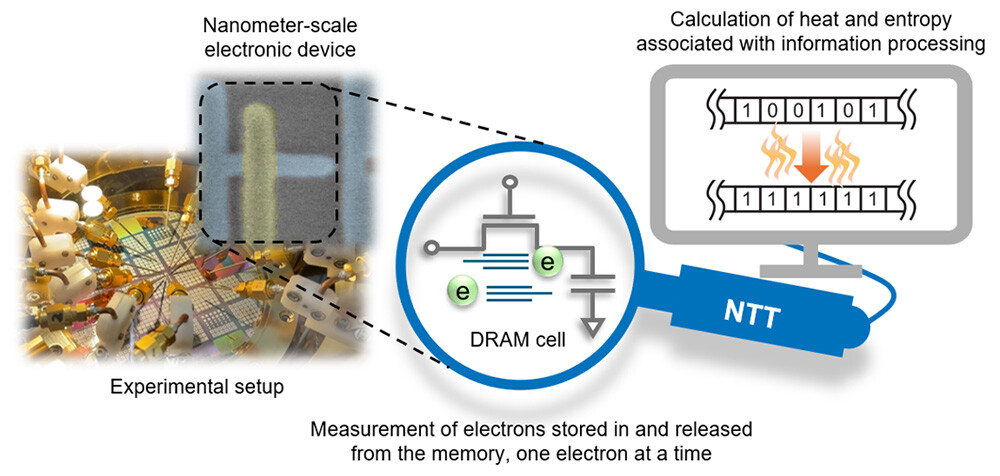 Figure 1. Overview of this study
Background
Improving the energy efficiency of information processing has become an urgent challenge as the widespread adoption of generative AI continues to drive rapid growth in electricity consumption. As a result, extensive research and development efforts are underway. At the same time, recent advances have revealed a fundamental relationship between information and thermodynamics. For example, information processing involves an initialization operation that resets information from multiple possible states to a predetermined state. During this process, entropy, which represents the uncertainty of the information, decreases, and heat is generated as a consequence, resulting in energy consumption. The theoretical minimum energy required for this process is known as the Landauer limit3 and serves as a fundamental benchmark for energy-efficient information processing (Figure 2). However, actual electronic devices consume far more energy than this theoretical limit, and identifying the cause of this discrepancy has become a key challenge in the development of energy-efficient devices.
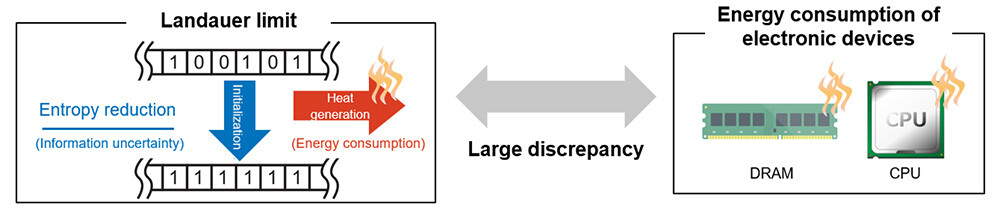 Figure 2. Schematic illustration of the Landauer limit and the discrepancy between the Landauer limit and the energy consumption of electronic devices
Conventionally, this discrepancy has been attributed to the effects of high-speed operation and peripheral circuits, but this hypothesis had not been experimentally verified. NTT has previously conducted research on the relationship between information and thermodynamics, including the experimental demonstration of power generation based on Maxwell's demon4. In this study, NTT investigated the fundamental energy limit of information processing in electronic devices. Specifically, to eliminate the effects of high-speed operation and peripheral circuits, the study focused on the circuit structure of a DRAM cell, the smallest memory unit that stores one bit of information in a dynamic random-access memory (DRAM) device (Figure 3), and examined whether the Landauer limit could be reached when the initialization operation was performed at a sufficiently slow speed.
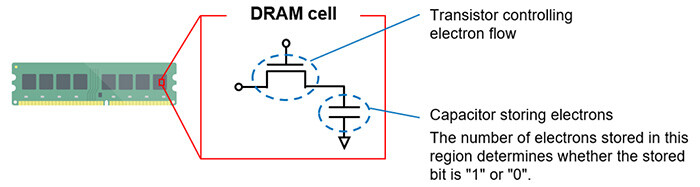 Figure 3. Circuit structure of the DRAM cell investigated in this study
However, this verification posed a significant technical challenge. Under conditions approaching the Landauer limit, the entropy and heat signals required for the measurements become extremely small and are easily obscured by noise. Until now, no method had been available to measure these quantities in semiconductor devices operating at room temperature.
Technical Highlights
NTT addressed this challenge by applying its proprietary single-electron detection technology based on a silicon nanodevice. Specifically, using a high-performance detector fabricated through advanced microfabrication technology (Figure 4(a, b)), the research team measured the amount of charge stored in the capacitor with single-electron resolution (Figure 4(c)). This information enabled successful evaluation of both heat and entropy using the following methods.
- Heat measurement
During information processing, electrons move between the lead and the capacitor, generating heat (either heat generation or heat absorption) depending on the potential difference between them. Therefore, the amount of heat can be calculated if the electrical potentials of the lead and the capacitor are known at the moment the electron moves. In this study, the capacitor potential was determined from the measured charge, and the heat was calculated by combining it with the lead potential, which was known from the externally applied voltage (Figure 4(d, e)). - Entropy measurement
Entropy is a physical quantity calculated from the probability distribution of information. Because the charge stored in the capacitor, which determines the information stored in the DRAM cell, can be measured with single-electron resolution, the information can be determined accurately, enabling entropy to be calculated (Figure 4(f)).
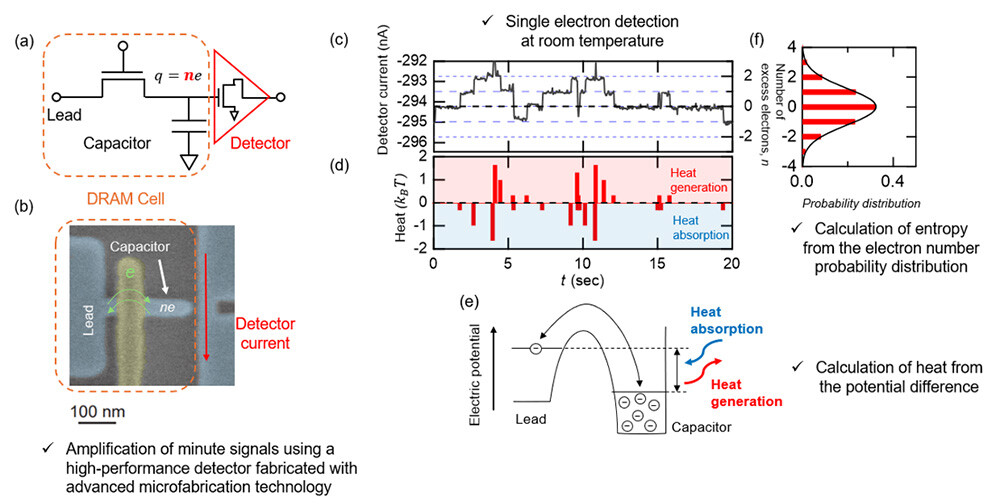 Figure 4. Device structure and measurement method.
(a) Equivalent circuit of the device.
(b) Scanning electron microscope image of the device.
(c) Representative detector current measurement. Changes in the number of electrons stored in the capacitor appear as discrete changes in the detector current.
(d) Heat generated or absorbed during each electron transfer. The vertical axis is expressed in units of the thermal energy at 27℃ (kBT = 25.9 meV).
(e) Schematic illustration of the method used to calculate heat.
(f) Measured probability distribution of the number of electrons.
Experimental Overview
In a DRAM cell, one bit of information is stored according to the amount of charge accumulated in the capacitor. Increasing the amount of charge injected during the initialization operation reduces the initialization error rate caused by thermal fluctuations5, resulting in a greater reduction in entropy. To investigate the relationship between entropy reduction and heat generation, the amount of injected charge was varied over multiple operating conditions.
The results showed that the greater the entropy reduction, the larger the amount of heat generated, and the more rapidly it increased (Figure 5). This indicates that as the initialization error rate decreases, the amount of heat generated deviates further from the Landauer limit. These findings demonstrate that the discrepancy cannot be explained solely by the effects of high-speed operation and peripheral circuits, providing important new insight that challenges the conventional understanding.
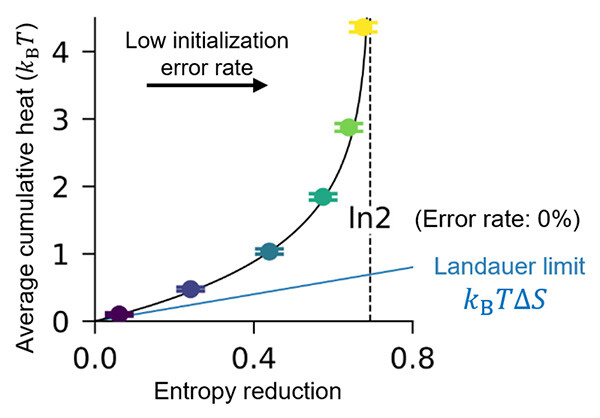 Figure 5. Measured relationship between entropy reduction and average cumulative heat generation. The vertical axis is expressed in units of the thermal energy at 32℃ (kBT = 26.3 meV). ΔS denotes the entropy reduction.
Further detailed analysis revealed that because a DRAM cell stores information in a thermally unstable (nonequilibrium) state, additional heat is generated during the initialization operation when the stored information transitions to a thermally stable (equilibrium) state. As a result, the Landauer limit cannot be achieved. These findings indicate that realizing energy-efficient memory devices approaching the Landauer limit will require memory structures capable of storing information in a thermally stable state.
Future Outlook
This technology enables the quantitative evaluation of entropy and heat in DRAM cell structures. Furthermore, it can be applied to the evaluation of other circuit architectures. By extending this approach to a wide range of information processing circuits, it is expected to help identify circuit architectures with superior energy efficiency.
Building on the findings of this study, NTT aims to develop new energy-efficient memory devices that surpass conventional DRAM cells, as well as novel computing technologies that harness thermal fluctuations as a computational resource.
Publication
Journal: Physical Review Letters
Title: Thermodynamic Constraints in Dynamic Random-Access Memory Cells: Experimental Verification of Energy Efficiency Limits in Information Erasure
Authors: Takase Shimizu, Kensaku Chida, Gento Yamahata, Katsuhiko Nishiguchi
DOI: https://doi.org/10.1103/1sgm-dhys
URL: https://journals.aps.org/prl/abstract/10.1103/1sgm-dhys
Glossary
1Entropy
In this study, entropy refers to information entropy (Shannon entropy), defined as: S = -∑i pi ln pi where pi is the probability that the system is in logical state i at a given moment. Information entropy increases as the probability distribution over the possible states becomes more uniform, meaning the uncertainty of the information increases. For example, the information entropy is higher when the value of a one-bit memory is unknown (it could be either 0 or 1) than when it is known with certainty to be 0.
2Nanometer
A unit of length equal to one billionth of a meter (10⁻⁹ m), commonly used to describe the dimensions of state-of-the-art electronic devices and fabrication technologies.
3Landauer Limit
The theoretical minimum amount of heat that must be dissipated during an information-processing operation that reduces information entropy. This lower bound is derived from the second law of thermodynamics, which requires that a decrease in information entropy be accompanied by a corresponding increase in thermodynamic entropy.
4Maxwell's Demon
A device that measures the microscopic states of particles or systems arising from thermal fluctuations and performs operations based on the measurement results (feedback control). In 2017, NTT experimentally demonstrated electrical power generation using Maxwell's demon.
Electrical current generation by sorting thermal noise --Power generation with Maxwell's demon-- | Press Release | NTT
5Initialization Error Rate
The fraction of memory cells that fail to reach the intended state during an initialization operation. For example, when all bits are initialized to 1, as shown in Figure 2, the initialization error rate is the proportion of bits that remain 0. A lower initialization error rate results in less uncertainty in the initialized information and therefore lower information entropy. Consequently, the reduction in entropy during initialization becomes greater.
About NTT
NTT is a leading global technology innovator, providing a broad range of services to both consumers and businesses. As a mobile operator and provider of infrastructure, networks, and services, NTT is dedicated to promoting a sustainable future through cutting-edge innovations. Our portfolio includes business consulting, AI-powered solutions, application services, global networks, cybersecurity, data center and edge computing, all supported by our deep global industry expertise. Generating over $90 billion in revenue and employing 340,000 professionals, we allocate 30% of our annual profits to fundamental research and development. With operations spanning more than 70 countries and regions, our clients include over 75% of Fortune Global 100 companies, alongside thousands of enterprises, government organizations, and millions of consumers.
Media Contact
NTT, Inc.
NTT Science and Core Technology Laboratory Group
Public Relations
Inquiry form
Information is current as of the date of issue of the individual press release.
Please be advised that information may be outdated after that point.


NTT STORY
WEB media that thinks about the future with NTT