Microsoft ends support for Internet Explorer on June 16, 2022.
We recommend using one of the browsers listed below.
- Microsoft Edge(Latest version)
- Mozilla Firefox(Latest version)
- Google Chrome(Latest version)
- Apple Safari(Latest version)
Please contact your browser provider for download and installation instructions.



March 26, 2026
NTT, Inc.
Development of CO2 Emissions Calculation Rules Covering the Entire Software Lifecycle and Promoting the Creation of Low-Carbon Software Businesses
— Covering procurement, development, operation, and disposal to enable green procurement and Scope 3 emissions calculation —
News Highlights:
- The rules for calculating CO₂ emissions, previously limited to the software procurement and development stages (Cradle-to-Gate), have been expanded to cover the entire lifecycle, from procurement and development to operation and end of life (Cradle-to-Grave), and have been formulated to be consistent with the Ministry of Economy, Trade and Industry's Carbon Footprint Guidelines.
- By enabling CFP (Carbon Footprint of Product) assessments across the entire lifecycle, this initiative supports the development of strategies to minimize CO₂ emissions associated with software products and promotes emissions reduction throughout the supply chain.
TOKYO — March 26, 2026 — NTT, Inc. (Headquarters: Chiyoda-ku, Tokyo; President and CEO: Akira Shimada; hereinafter "NTT") participated in and led discussions within the Japan Environment Club*1 Study Group on Decarbonization in the Software Sector as part of its efforts to advance decarbonization in the software field, and formulated rules for calculating CO₂ emissions covering the entire lifecycle of software products.*2 These rules enable the calculation of CO₂ emissions associated with the procurement, development, operation, and end of life of software products consistent with the Ministry of Economy, Trade and Industry's Carbon Footprint Guidelines.*3 This initiative is expected to promote green procurement and enhance corporate value through applications such as Scope 3 emissions calculation and reporting.
Going forward, the NTT Group will promote the use of these calculation rules and work to create new businesses related to low-carbon software development and operations.
Background
As the development and use of AI continue to expand, the risk of increased environmental impact from the ICT industry is also growing,*4,5 drawing attention to the sustainability of AI technologies composed of software, as well as data centers. While software itself does not directly consume physical resources, it indirectly increases energy consumption through the use of cloud services, data centers, networks, and user devices, thereby affecting the overall environmental impact of the ICT sector. At the same time, there has been a growing societal demand in recent years for the disclosure of corporate Scope 3 emissions, and CO₂ emissions associated with software products are becoming increasingly important in procurement evaluations and business decisions.
In March 2024, under the Ministry of Economy, Trade and Industry's Study Group on Product Carbon Footprint Calculations and Verification for Supply Chain-Wide Carbon Neutrality, Cradle-to-Gate*6 calculation rules (v1.0) were established, enabling the evaluation of CO₂ emissions at the development stage. However, as software products are typically used over long periods after development, assessing CO₂ emissions across the entire lifecycle, including operation and end of life, has remained a key challenge.
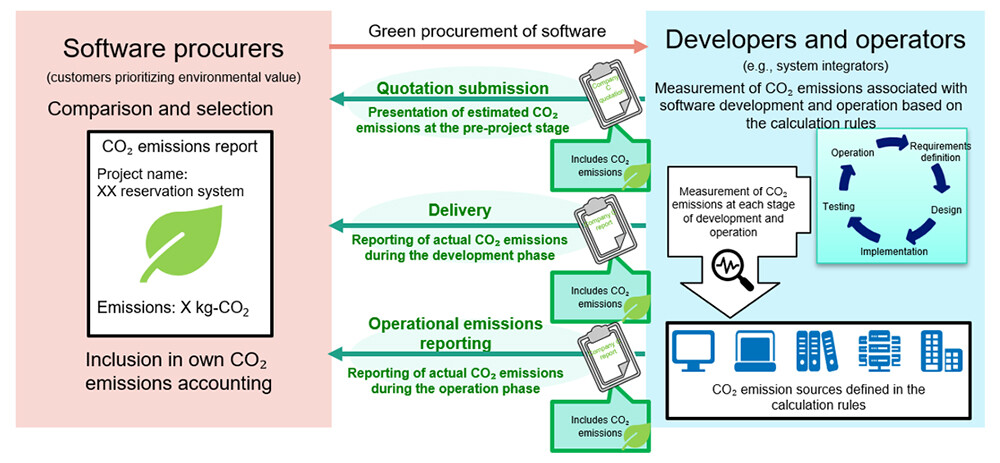 Figure 1. Conceptual image of green software procurement, development, and operation
Results
Within the Japan Environment Club Study Group on Decarbonization in the Software Sector, Cradle-to-Grave*7 calculation rules were established, expanding the scope of conventional rules that had been limited to the procurement and development stages to cover the entire lifecycle. These rules enable the calculation of CO₂ emissions from procurement, development, operation, and end of life consistent with the Ministry of Economy, Trade and Industry's Carbon Footprint Guidelines, thereby establishing a foundation for formulating strategies to reduce CO₂ emissions associated with software and for promoting the greening of the entire supply chain.
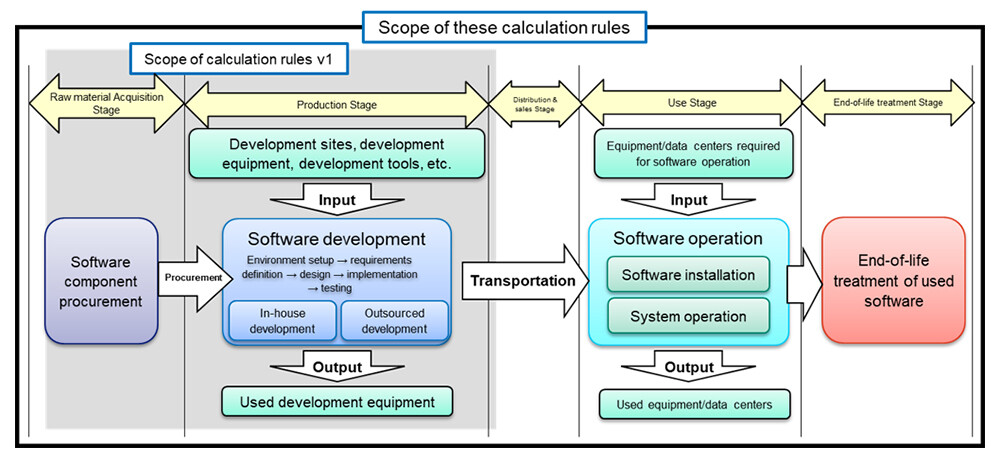 Figure 2. Conceptual illustration of the software product lifecycle flow defining the scope of calculation
Key Points of the Calculation Rules
(1) Definition and systematization of lifecycle-wide CO₂ emissions assessment boundaries for software products
Conventionally, CO₂ emissions assessments for software have generally been limited either to the development stage or to comprehensive evaluations of entire ICT services and systems. To enable more granular CO₂ emissions assessments, these calculation rules focus on software products that constitute ICT services and systems, and define and systematize emission sources and calculation processes to be considered not only at the procurement and development stages, but also during operation and disposal. This clarifies the system boundaries for lifecycle-wide assessment. For example, emissions can be calculated separately for procurement, development, operation, and end of life, making it possible to identify whether emissions at a given stage are relatively high or low and to appropriately evaluate CO₂ emissions across the software product lifecycle.
(2) Enabling CO₂ emissions estimation at the quotation stage
Previously, estimating CO₂ emissions during software operation at the quotation stage required approaches such as calculations based on development costs, which often resulted in discrepancies from actual emissions. These calculation rules define and systematize events and emission sources associated with software operation, improving the accuracy of CO₂ emissions estimates at the quotation stage and enabling their use in green procurement and design decisions.
(3) Practical, globally applicable calculation rules
These calculation rules were developed with the aim of application not only in Japan but also across the global software industry. In addition to environmental experts, engineers involved in software development participated in the review and discussion of the rules, resulting in practical guidelines that reflect real-world operations.
Role of NTT
NTT conducted experimental measurements of power consumption from software operation through to end of life and analyzed processes that could serve as major sources of CO₂ emissions. Leveraging these insights, NTT proposed a draft of the calculation rules and, as chair of the Japan Environment Club Study Group on Decarbonization in the Software Sector, led discussions and consensus building among participating organizations.
Future Outlook
Going forward, the NTT Group will promote the adoption of these calculation rules both within and outside the group and accumulate practical calculation results. Based on insights*8,9 into the breakdown and characteristics of CO₂ emissions identified through power consumption measurement experiments in individual cases, NTT will analyze trends in CO₂ emissions arising from differences in software products and usage conditions and drive the development of effective reduction technologies. In addition, the NTT Group will advance the creation of new businesses related to low-carbon software development and operations.
By promoting the calculation, disclosure, and certification of CO₂ emissions for software products based on these rules, NTT aims to create a world in which environmental performance is a key factor in the software market. Software developers will be able to demonstrate value by delivering low-emission software, while procuring organizations can use calculation results for their Scope 3 emissions calculation and reporting, thereby enhancing corporate value.
In addition, the NTT Group will work toward international standardization to establish these calculation rules as widely adopted common guidelines.
Related Previous Announcements
- March 29, 2024: https://group.ntt/en/newsrelease/2024/03/29/240329a.html
- January 28, 2025: https://group.ntt/jp/topics/2025/01/28/lca_21th.html (Japanese)
[Glossary]
*1Japan Environment Club
A non-profit organization that conducts networking, research, and policy support activities to address economic and social issues, with a focus on global environmental challenges. It establishes study groups on specific themes related to the environment, economy, and society to facilitate discussion.
https://www.kankyouclub.or.jp/ (Japanese)
*2The formulated rules are published by the LCA Japan Forum (Secretariat: Japan Environmental Management Association for Industry)
https://lca-forum.org/member/guidelines.html#kubun1-1 (Japanese)
*3Ministry of Economy, Trade and Industry and Ministry of the Environment, Carbon Footprint Guidelines
https://www.meti.go.jp/shingikai/energy_environment/carbon_footprint/pdf/20230526_3.pdf (Japanese)
*4Andrae, A.S.G and Elder, T. (2015) On Global Electricity Usage of Communication Technology: Trends to 2030. Challenges 2015, 6, pp. 117-157
https://www.mdpi.com/2078-1547/6/1/117
*5International Energy Agency. (2025) Energy and AI World Energy Outlook Special Report. pp. 14
https://www.iea.org/reports/energy-and-ai
*6Cradle to gate
Refers to the lifecycle stages from raw material procurement through production, within the overall lifecycle that includes procurement, production, distribution, sales, use and maintenance, and disposal and recycling.
*7Cradle to grave
Refers to all lifecycle stages.
*8Machiko Shinozuka et al. (2026) "An analysis of Carbon footprint of software development in Cradle-to-gate," Journal of Life
Cycle Assessment, Japan, 22(1), pp. 56–66
https://www.jstage.jst.go.jp/article/lca/22/1/22_56/_pdf/-char/ja
*9Ohri Yamaguchi et al. (2025) A Case Study on the Estimation of Life-Cycle CO₂ Emissions in Software. Proceedings of EcoDesign 2025 International Symposium.
About NTT
NTT is a leading global technology innovator, providing a broad range of services to both consumers and businesses. As a mobile operator and provider of infrastructure, networks, and services, NTT is dedicated to promoting a sustainable future through cutting-edge innovations. Our portfolio includes business consulting, AI-powered solutions, application services, global networks, cybersecurity, data center and edge computing, all supported by our deep global industry expertise. Generating over $90 billion in revenue and employing 340,000 professionals, we allocate 30% of our annual profits to fundamental research and development. With operations spanning more than 70 countries and regions, our clients include over 75% of Fortune Global 100 companies, alongside thousands of enterprises, government organizations, and millions of consumers.
Media Contact
NTT, Inc.
NTT IOWN Integrated Innovation Center
Public Relations
Inquiry Form
Information is current as of the date of issue of the individual press release.
Please be advised that information may be outdated after that point.


NTT STORY
We introduce various fields that NTT Group is working on and collaborations with partners.