Microsoft ends support for Internet Explorer on June 16, 2022.
We recommend using one of the browsers listed below.
- Microsoft Edge(Latest version)
- Mozilla Firefox(Latest version)
- Google Chrome(Latest version)
- Apple Safari(Latest version)
Please contact your browser provider for download and installation instructions.



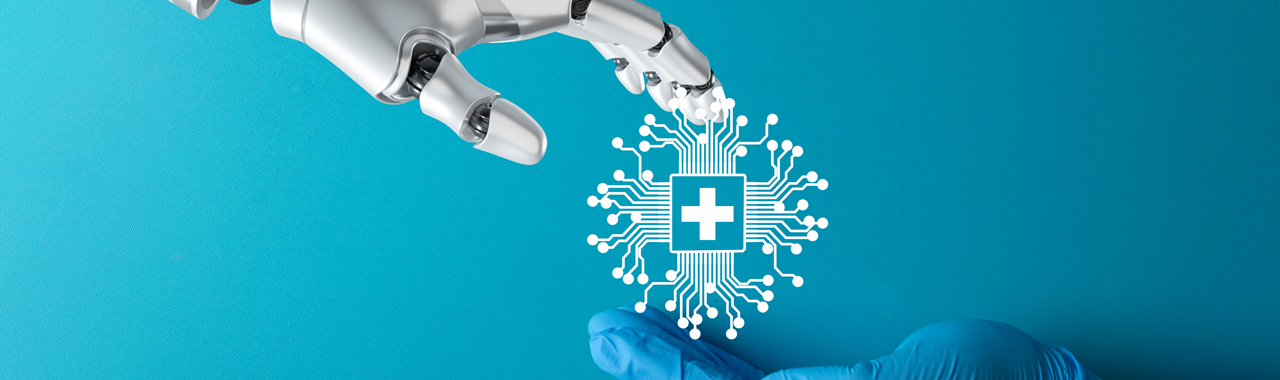
Telemedicine has completely changed the way we think about healthcare over the past decade.
We now have high‑speed networks, smartphones, cloud platforms, and secure video links that make it possible for doctors and patients to see and hear each other across the entire world. And for many consultations, that's enough. If you have a rash, you can show your doctor via your computer's camera. You can talk about getting a prescription. Your doctor can share test results with you instantly.
There's a Problem
But there's still one thing missing: touch. The doctor on the other end of your webcall can hear you describe how something hurts or is swollen, but they can't feel for themselves.
There's a word for when medical professionals examine the body by pressing it with their hands: palpation. They press the abdomen to check for tenderness. They feel for swollen lymph nodes. They test joints and muscles. Laying hands on patients gives doctors a huge amount of clinical information.
All of which raises the question: what happens when the doctor is remote and can't touch the patient?
Touch, Remotely
Researchers from NTT Human Informatics Laboratories have been trying to answer that question with their work on remote palpation, where the sense of touch is transmitted across distance.
A typical scenario might be where a nurse, caregiver, or trained family member is with the patient, and a doctor connects remotely. Through a shared interface, the doctor gives precise instructions about where and how to press, indicating palpation points directly on a screen using a cursor. Those instructions are synchronized with the view seen by the person attending the patient. Visual overlays can be superimposed on the live video feed, guiding finger placement and movement, so that the remote examination more closely resembles face‑to‑face clinical instruction.
When the attendant presses the patient’s body, sensors measure two things: the force applied by the fingertips and the amount the tissue moves in response; a fingertip pressure sensor captures the applied force, while a depth sensor measures the displacement of the skin surface as it is pressed.
Calculating Tissue Condition
Softness is related to compliance, the degree to which tissue deforms under a given force. Soft tissue deforms more for the same amount of pressure, while firmer tissue deforms less. By combining pressure data with displacement data in real time, the system can then make calculations. The softness of the tissue is worked out from the interaction between the two measurements, allowing the system to estimate how resistant or compliant the tissue is under controlled pressure. In this way, the remote doctor is able to understand how “soft” or “hard” the tissue of the patient is, in a way similar to how they'd feel it for themselves during an in‑person examination.
The video consultation and tactile data are synchronized so that instruction, measurement, and feedback all happen in the same interaction. On the doctor’s side, a haptic display recreates what the attendant is feeling. Beneath the doctor’s fingertips is a surface made up of many tiny actuators, which move up and down to simulate resistance. As new measurements arrive, the system adjusts the actuators in real time, producing a changing pattern of pressure. In effect, the doctor feels a version of the same softness or firmness that the attendant feels while pressing the patient.
Not Yet Ready, But Full of Promise
It's early days and NTT's work is still at the prototype stage, but if remote palpation can be made reliable, affordable, and clinically validated, it has a huge potential reach.
- Home‑care patients monitored more frequently, without repeated hospital visits
- Elderly people in rural areas receiving specialist oversight, without long journeys
- A single doctor supervising multiple attendants across a wide area, able to make the kind of physical assessment not possible through simple video calls alone
One extra benefit of the system is its digital nature, which means that the touch measurements taken are converted into data, which can be stored and compared over time. Even small changes in swelling or tissue firmness could be tracked, enabling long-term care that doesn't depend on the memory and experience of individuals.
The technology is still at an early stage and clinical trials need to compare remote palpation with in‑person examinations. The devices used to capture and reproduce tactile sensations have to be made more compact and durable. What's more, latency and reliability have to be proven, so as to support a seamless clinical experience. And finally, regulatory approval is required before remote palpation could become a reality.
But what potential. Medicine has always relied on humans relating directly to humans. Remote technologies have expanded access to care, but haven't yet been able to deliver a human touch. Restoring that personal element could deliver the next stage of telemedicine, where distance is no longer a barrier to getting a helping hand.
Innovating a Sustainable Future for People and Planet
For further information, please see this link:
https://www.rd.ntt/forum/2025/doc/D06-e.pdf
If you have any questions on the content of this article, please contact:
NTT Human Informatics Laboratories
https://tools.group.ntt/en/rd/contact/index.php?param01=F¶m02=201¶m03=D06
Daniel O'Connor
Daniel O'Connor joined the NTT Group in 1999 when he began work as the Public Relations Manager of NTT Europe. While in London, he liaised with the local press, created the company's intranet site, wrote technical copy for industry magazines and managed exhibition stands from initial design to finished displays.
Later seconded to the headquarters of NTT Communications in Tokyo, he contributed to the company's first-ever winning of global telecoms awards and the digitalisation of internal company information exchange.
Since 2015 Daniel has created content for the Group's Global Leadership Institute, the One NTT Network and is currently working with NTT R&D teams to grow public understanding of the cutting-edge research undertaken by the NTT Group.
Related Article
Recommended Article
-
March 14, 2024
What is NTT's GX? Our solution brand "NTT G×Inno"
-

March 5, 2024
[Press Conference Information] Launch of "NTT G×Inno," a New Solution Brand to Strengthen Efforts in the GX Field
-
January 15, 2024
Digitization and Digitization for Smart Agriculture
-
November 17, 2023
Realizing a Recycling-Oriented Society through a Data Mining Approach
Search by Tags